
Hajj Guide from India with SafaTrips
Hajj Guide helps pilgrims understand how to prepare for Hajj, what documents are needed, how the journey works, what rituals are performed, and how to choose the right Hajj package from India. Hajj is one of the five pillars of Islam and is performed in Makkah during the Islamic month of Dhul Hijjah by Muslims who are physically and financially able.
For many Indian pilgrims, Hajj is a once-in-a-lifetime journey. It is not like a normal holiday or simple international trip. It includes worship, travel rules, group movement, official permissions, health preparation, flights, hotels, meals, local transport, and rituals in different sacred places.
SafaTrips helps Indian pilgrims understand the Hajj journey in a simple and practical way. Our aim is to make this guide easy enough for first-time pilgrims, families, senior citizens, and private groups to understand.
The Saudi Ministry of Hajj and Umrah is the official Saudi authority for Hajj-related services and guidelines, while the Haj Committee of India issues official guidelines for Indian pilgrims applying through the government channel. Pilgrims should always check updated official rules before final booking because Hajj rules, dates, service arrangements, and travel requirements can change.
For complete package planning, pilgrims can also explore SafaTrips Hajj Packages.
What Is Hajj?
Hajj is the annual Islamic pilgrimage to Makkah. It is compulsory once in a lifetime for Muslims who are physically, mentally, and financially able to perform it. Hajj is performed on specific dates in Dhul Hijjah and includes important rituals in Makkah, Mina, Arafat, Muzdalifah, and other sacred places.
Hajj teaches patience, equality, sacrifice, discipline, forgiveness, and complete submission to Allah. Pilgrims from different countries, languages, and backgrounds wear simple clothing and perform the same acts of worship.
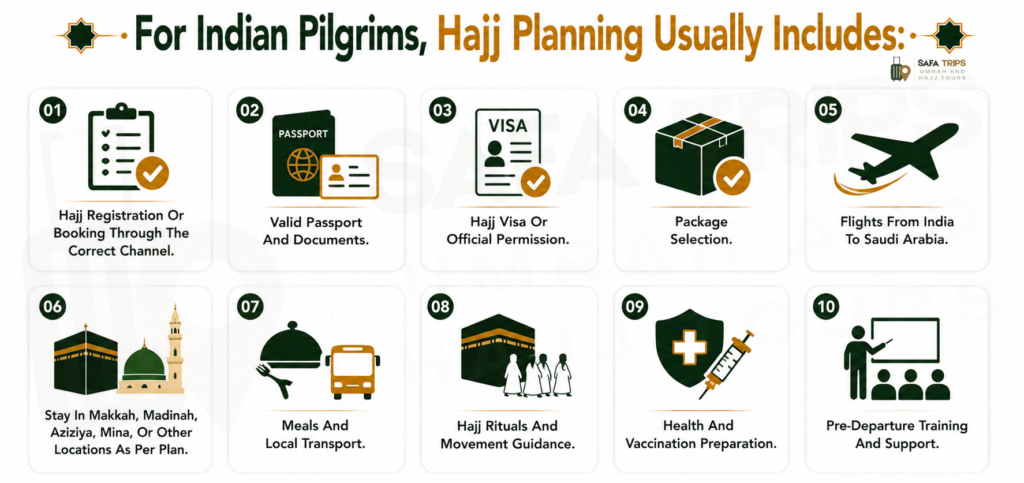
For Indian pilgrims, Hajj planning usually includes:
- Hajj registration or booking through the correct channel.
- Valid passport and documents.
- Hajj visa or official permission.
- Package selection.
- Flights from India to Saudi Arabia.
- Stay in Makkah, Madinah, Aziziya, Mina, or other locations as per plan.
- Meals and local transport.
- Hajj rituals and movement guidance.
- Health and vaccination preparation.
- Pre-departure training and support.
This is why a proper Hajj Guide is important before booking.
Important Note About Hajj Visa Cost
Many pilgrims ask about Hajj visa cost. The correct point is important:
The official Saudi Hajj visa is issued free of charge, but you cannot apply for it individually. To perform Hajj from India, you must go through a registered operator and pay associated administrative, travel, and accommodation packages.
This means the Hajj visa itself is not the main cost. The real cost comes from the complete package, which may include flights, hotels, meals, transport, Mina arrangements, Mashair services, support staff, administrative work, and other travel services.
The Nusuk Hajj platform explains that Hajj packages can include services such as visa issuance, flights, accommodation, catering, transport, Mashair services, and guidance. This is why pilgrims should understand the full package, not just the visa part.
For detailed visa support, you can read SafaTrips Hajj Visa Services.
Hajj Guide
| Hajj Planning Area | What Pilgrims Should Know |
|---|---|
| Main purpose | Worship and pilgrimage to Makkah |
| Main season | Dhul Hijjah |
| Main places | Makkah, Mina, Arafat, Muzdalifah |
| Main clothing | Ihram for men; modest Islamic dress for women |
| Main documents | Passport, photos, identity proof, vaccination, package papers |
| Visa note | Official Hajj visa is free, but package cost applies |
| Travel style | Group-based or package-based travel |
| Best planning time | As early as possible |
| SafaTrips support | Packages, visa guidance, hotels, flights, meals, transport, preparation |
Who Should Read This Hajj Guide?
This Hajj Guide is useful for anyone planning Hajj from India, especially:
First-time pilgrims : If you are going for Hajj for the first time, you may feel confused about documents, rituals, travel movement, and package options. This guide explains the journey in simple language.
Families : Family Hajj needs careful planning because room sharing, meals, health, luggage, and group movement must be clear.
Senior citizens : Elderly pilgrims need more comfort, rest, transport support, and medical preparation.
Private groups : Small groups need better coordination, package selection, and clear communication.
Budget-conscious pilgrims : If you want a practical package, you should understand what is included before choosing the lowest price.
Comfort-focused pilgrims : If you want premium hotels, smoother transport, and better support, you should compare luxury package options early.
Main Types of Hajj
Hajj has different types based on how the pilgrim combines Hajj and Umrah. Pilgrims should follow the guidance of their scholar, operator, or group leader.
Hajj Tamattu
In Hajj Tamattu, the pilgrim performs Umrah first, comes out of Ihram, and then enters Ihram again for Hajj. This is common for many international pilgrims.
Hajj Qiran
In Hajj Qiran, the pilgrim performs Umrah and Hajj together with one Ihram. The pilgrim remains in Ihram until the required stage.
Hajj Ifrad
In Hajj Ifrad, the pilgrim performs only Hajj without Umrah. This is often associated with pilgrims living closer to Makkah, but guidance should be taken before deciding.
Most Indian pilgrims should not decide the Hajj type alone. They should follow the package guidance, religious scholar, or tour manager instructions.
Step-by-Step Hajj Guide
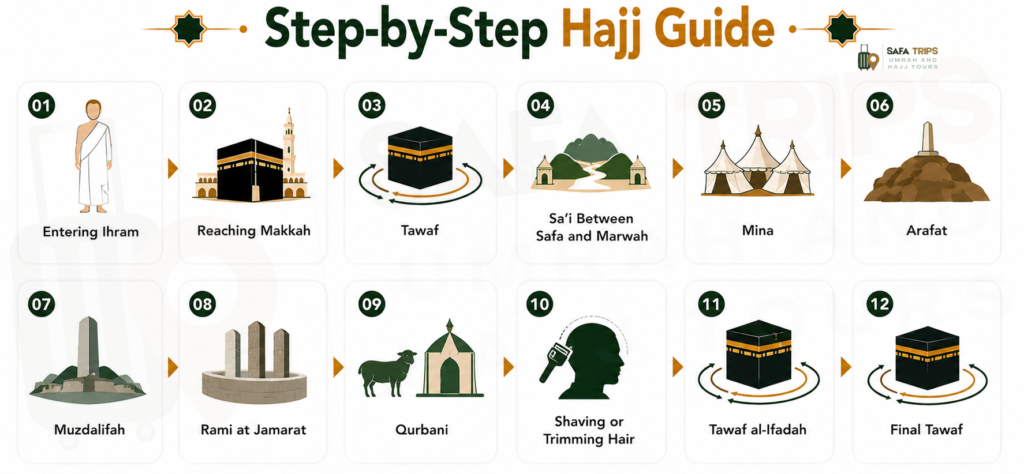
Hajj rituals should be performed with proper intention, patience, and guidance. Below is a simple step-by-step explanation for understanding.
1. Entering Ihram
Ihram is the sacred state a pilgrim enters before performing Hajj. Men wear two white unstitched cloths. Women wear modest Islamic clothing that covers properly, without wearing a face veil or gloves during Ihram according to common guidance.
In Ihram, pilgrims must avoid certain actions. They should control anger, avoid arguments, avoid cutting hair or nails, avoid perfume, and stay focused on worship.
Simple Ihram preparation tips:
- Take a bath before Ihram where possible.
- Wear clean Ihram clothing.
- Make intention for Hajj.
- Recite Talbiyah.
- Keep patience during travel.
- Avoid fighting, shouting, or wasting time.
- Listen carefully to group guidance.
2. Reaching Makkah
After entering Saudi Arabia, pilgrims travel according to the package plan. Some may go to Makkah first, while others may visit Madinah first depending on the package route.
When reaching Makkah, pilgrims should stay calm. The journey can be tiring. Senior citizens and families should rest, drink water, and follow the group leader’s instructions.
3. Tawaf
Tawaf means walking around the Kaaba seven times. It is one of the most emotional parts of the journey. Pilgrims should perform Tawaf with humility, dua, and focus.
During crowd time, pilgrims should avoid pushing. It is better to move slowly and safely than to rush.
Tawaf safety tips:
- Stay with your group.
- Keep elderly pilgrims close.
- Do not push others.
- Avoid taking too many photos.
- Drink water when needed.
- Keep slippers safely if required.
- Follow official crowd instructions.
4. Sa’i Between Safa and Marwah
Sa’i means walking seven times between Safa and Marwah. It reminds pilgrims of the struggle and trust of Hajar (peace be upon her). This act teaches patience, hope, and reliance on Allah.
Pilgrims should walk calmly. Senior citizens may use wheelchair support where available and suitable.
5. Mina
Mina is an important part of Hajj. Pilgrims stay in tents and prepare for the Day of Arafat. Mina can be crowded, so discipline is important.
Pilgrims should keep their ID, group details, and important documents safe. They should not wander away without informing their group.
6. Arafat
The Day of Arafat is one of the most important days of Hajj. Pilgrims stand in Arafat, make dua, seek forgiveness, and remember Allah.
This day should not be wasted. Pilgrims should avoid unnecessary talking and focus on dua, repentance, and worship.
What to do on Arafat:
- Make sincere dua.
- Ask Allah for forgiveness.
- Recite Qur’an if possible.
- Send blessings upon the Prophet ﷺ.
- Avoid arguments.
- Stay hydrated.
- Help elderly pilgrims.
- Follow group movement instructions.
7. Muzdalifah
After Arafat, pilgrims move to Muzdalifah. They spend the night there and collect pebbles for Rami. Conditions can be simple, so pilgrims should be mentally prepared.
Carry light items and follow the group. Do not panic if the movement is slow because millions of pilgrims are moving together.
8. Rami at Jamarat
Rami means throwing pebbles at the pillars in Jamarat. It symbolises rejecting Shaytan and staying firm on faith.
This area can be crowded. Pilgrims must follow timing and movement rules. Senior citizens should take extra care and follow package guidance.
9. Qurbani
Qurbani or sacrifice is part of the Hajj process for many pilgrims depending on Hajj type. In most package arrangements, Qurbani may be coordinated through authorised systems.
Pilgrims should confirm whether Qurbani is included in their package or needs to be arranged separately.
10. Shaving or Trimming Hair
After key rituals, men shave their hair. Women cut a small portion of hair as per Islamic guidance. This marks an important stage of coming out of Ihram restrictions.
11. Tawaf al-Ifadah
Tawaf al-Ifadah is one of the essential Hajj rituals. Pilgrims return to Makkah and perform Tawaf. It should be done with proper guidance and timing.
12. Final Tawaf
Before leaving Makkah, pilgrims usually perform Tawaf al-Wada, also called farewell Tawaf. It is a deeply emotional moment because pilgrims are saying farewell to the House of Allah.
Hajj Rituals
| Stage | Main Action |
|---|---|
| Ihram | Enter sacred state and make intention |
| Makkah | Tawaf and Sa’i as per Hajj type |
| Mina | Stay and prepare for Arafat |
| Arafat | Main day of dua and standing |
| Muzdalifah | Night stay and collect pebbles |
| Jamarat | Rami, throwing pebbles |
| Qurbani | Sacrifice where applicable |
| Hair cutting | Shaving or trimming |
| Tawaf al-Ifadah | Essential Tawaf after main rituals |
| Final Tawaf | Farewell Tawaf before leaving Makkah |
SafaTrips Hajj Package Options
A Hajj Guide is incomplete without understanding package planning. The package you choose affects comfort, travel movement, hotel stay, meals, transport, and support.
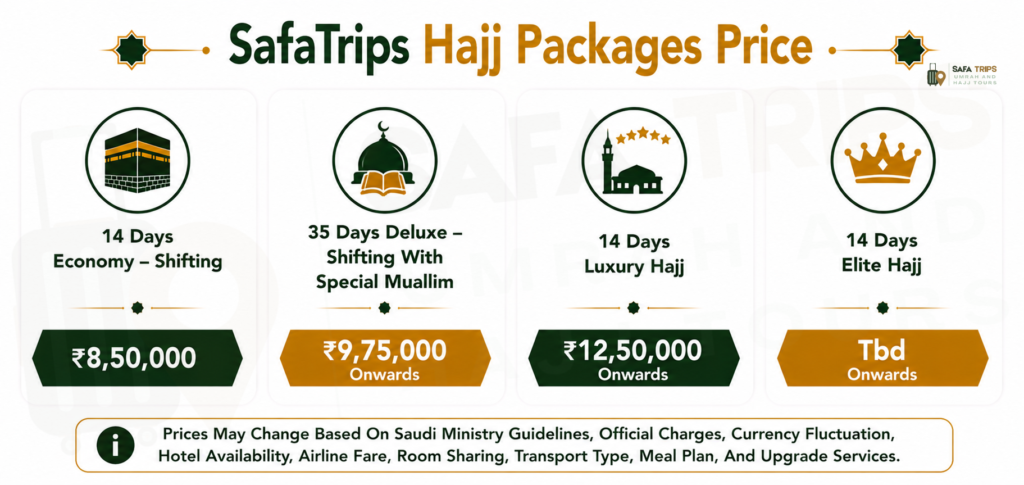
SafaTrips offers clear Hajj package options for Indian pilgrims.
| Package Name | Duration | Best For | Price |
|---|---|---|---|
| Economy – Shifting | 14 Days | Pilgrims who want a pocket-friendly guided Hajj plan | ₹8,50,000 per person |
| Deluxe – Shifting | 35 Days | Pilgrims who want longer stay and special Muallim support | ₹9,75,000 onwards per person |
| Luxury | Non-Shifting Short Package | Pilgrims who want premium comfort and smoother planning | ₹12,50,000 onwards per person |
| Elite | VIP Hajj Package | Pilgrims who want personalised premium support | On request |
Prices may increase based on travel month, airline fare, hotel distance, room sharing, direct flight availability, Hajj demand, Mina category, transport type, meals, Saudi service updates, and currency exchange.
Economy – Shifting Hajj Plan
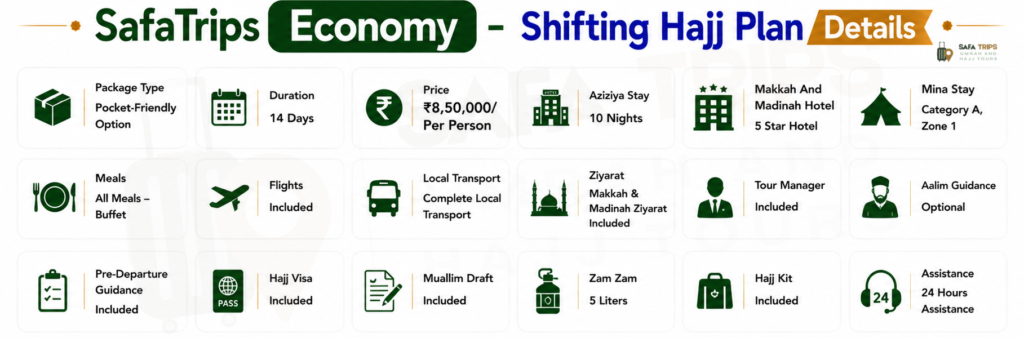
The Economy – Shifting package is a practical choice for pilgrims who want guided Hajj support at a controlled cost. It is a pocket-friendly option, but it still includes important services.
This plan is priced at ₹8,50,000 per person and has a 14-day duration.
It includes:
- Aziziya stay for 10 nights: Useful for shifting-based Hajj movement.
- 5 Star hotel in Makkah: Comfortable stay as per package.
- 5 Star hotel in Madinah: Stay in the blessed city as per plan.
- Mina stay in Category A, Zone 1: Important during Hajj days.
- All meals with buffet: Helps pilgrims maintain energy.
- Flights included: Makes travel planning easier.
- Complete local transport: Helps with movement during the journey.
- Makkah and Madinah Ziyarat: Important visits included.
- Tour manager: Helps with coordination.
- Aalim guidance optional: Religious support where required.
- Pre-departure guidance: Helps pilgrims prepare before travel.
- Hajj visa support: Included with package planning.
- Muallim draft: Included as per plan.
- 5 liters Zam Zam: Included.
- Hajj kit: Useful basic support for pilgrims.
- 24-hour assistance: Available as per package.
- Quality Assurance: Added service confidence.
Pilgrims who want this budget-friendly choice can explore Economy Hajj Packages.
Deluxe – Shifting Hajj Plan
The Deluxe – Shifting plan is suitable for pilgrims who want a longer stay and better support. It is helpful for families, first-time pilgrims, and people who prefer more time in Saudi Arabia.
This plan starts from ₹9,75,000 onwards per person and has a 35-day duration.
This package is useful because:
- It gives more time.
A longer stay can help pilgrims feel less rushed. - It includes special Muallim support.
Muallim support helps with Hajj movement and coordination. - It works well for families.
Families need better planning for meals, rooms, and group movement. - It is useful for first-time pilgrims.
First-time pilgrims may feel more comfortable with extra guidance and time.
Luxury Hajj Plan
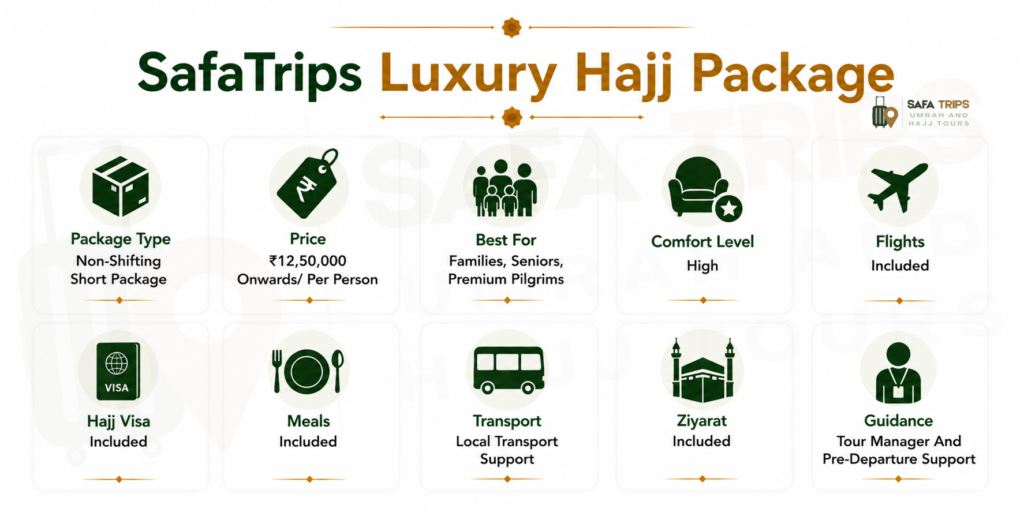
The Luxury Hajj plan is for pilgrims who want higher comfort and smoother travel. Hajj can be physically demanding, especially for senior citizens and families. A luxury plan can make the journey easier with better planning and premium support.
This plan starts from ₹12,50,000 onwards per person.
It is suitable for:
- Senior citizens.
- Couples.
- Families.
- VIP travellers.
- Comfort-focused pilgrims.
- Pilgrims who prefer short non-shifting arrangements.
- Private groups needing better service.
Pilgrims who want higher comfort can also read more about Luxury Hajj Packages.
Documents Needed for Hajj from India
Documents can change based on official rules, Saudi updates, and package requirements. Pilgrims should always confirm the latest list before booking.
Common documents may include:
- Valid passport with correct details.
- Passport-size photographs.
- Aadhaar or identity proof.
- Vaccination certificate where required.
- Medical fitness guidance.
- Package booking details.
- Payment proof.
- Emergency contact details.
- Nominee or family contact information.
- Copies of important documents.
The Haj Committee of India guidelines explain official rules for Indian pilgrims and should be checked for updated eligibility, application, payment, and travel instructions.
Health Preparation for Hajj
Hajj requires physical strength. Pilgrims walk, stand, wait, move in crowds, and spend time in hot weather. Health preparation should begin early.
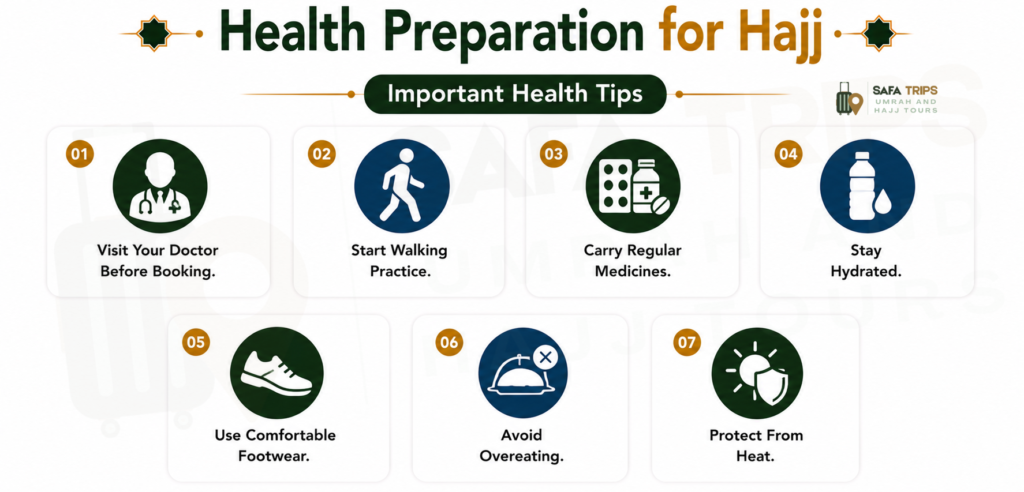
Important Health Tips
- Visit your doctor before booking.
Senior citizens and pilgrims with diabetes, heart issues, asthma, blood pressure, or mobility problems should take medical advice. - Start walking practice.
Daily walking helps the body prepare for Tawaf, Sa’i, Mina, Arafat, and other movement. - Carry regular medicines.
Keep medicines in original packaging with prescriptions where possible. - Stay hydrated.
Saudi weather can be hot. Drink water regularly. - Use comfortable footwear.
Good footwear helps reduce foot pain during long walking. - Avoid overeating.
Heavy food can make movement difficult. - Protect from heat.
Use an umbrella where allowed, rest when needed, and avoid unnecessary sun exposure.
Packing List for Hajj
Packing should be simple and useful. Pilgrims should avoid carrying too much luggage because Hajj movement can be tiring.
Basic Packing Items
- Passport and travel documents.
- Hajj package papers.
- ID cards and photocopies.
- Ihram clothes for men.
- Modest clothing for women.
- Comfortable slippers.
- Small prayer mat.
- Medicines and prescriptions.
- Unscented soap and toiletries.
- Reusable water bottle.
- Small bag for daily movement.
- Phone charger and power bank.
- Safety pins or Ihram belt.
- Sunglasses and umbrella.
- Light snacks if needed.
- Emergency contact list.
What Not to Overpack : Do not carry too many clothes, heavy bags, unnecessary electronics, expensive jewellery, or items that make movement difficult. Hajj is about simplicity and worship.
Hajj Guide for Senior Citizens
Senior citizens should plan Hajj with extra care. The journey can be tiring, and comfort becomes very important.
SafaTrips helps senior pilgrims choose packages based on health, movement ability, rest needs, and family support.
Senior Citizen Tips
- Choose comfort over lowest price.
A cheaper package may not always be suitable for elderly pilgrims. - Travel with a family member if possible.
Having someone close can make the journey safer. - Discuss mobility needs early.
If wheelchair support or easier transport is needed, ask before booking. - Keep medicines ready.
Carry enough medicines for the full journey plus extra days. - Rest when needed.
Do not copy younger pilgrims. Move according to your health. - Stay with the group.
Getting separated can be stressful in large crowds.
Hajj Guide for Families
Family Hajj requires careful planning. Every member may have different needs. Children, parents, elderly members, and women travellers should all be considered.
Family Planning Tips
- Check passports for every family member.
- Discuss room sharing before booking.
- Choose package based on comfort and budget.
- Keep children and elderly members close.
- Carry emergency contact details.
- Keep medicines and snacks ready.
- Follow group timing.
- Avoid separating during crowd movement.
- Keep document copies with more than one family member.
- Ask SafaTrips about family-friendly package options.
A family journey becomes easier when everyone knows the plan.
Hajj Guide for First-Time Pilgrims
First-time pilgrims should not feel worried. Hajj may look difficult at first, but with proper guidance, it becomes easier to understand.
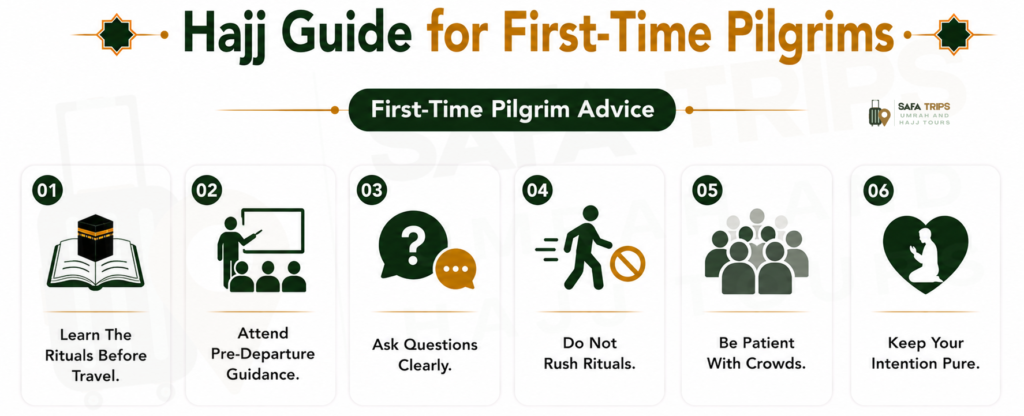
First-Time Pilgrim Advice
- Learn the rituals before travel.
Do not wait until reaching Saudi Arabia. Learn the basic steps early. - Attend pre-departure guidance.
Training helps you understand travel, rituals, group rules, and safety. - Ask questions clearly.
If you do not understand anything, ask before booking. - Do not rush rituals.
Perform everything calmly and safely. - Be patient with crowds.
Millions of people perform Hajj. Patience is part of the journey. - Keep your intention pure.
Hajj is for Allah. Avoid showing off, arguments, and unnecessary distractions.
For practical support before travel, SafaTrips offers Hajj Preparation Services.
Hajj Travel Route from India
The final travel route depends on package type, flight availability, airline schedule, and group plan. Some pilgrims may land in Jeddah first and go to Makkah. Some may land in Madinah first, stay there, and later travel to Makkah.
Common Indian departure preferences may include:
- Delhi.
- Mumbai.
- Hyderabad.
- Lucknow.
- Srinagar.
- Bangalore.
- Chennai.
- Kolkata.
- Kerala region.
SafaTrips helps pilgrims understand the best possible route based on package and availability.
Common Mistakes to Avoid During Hajj
Hajj is a journey of worship, but small mistakes can create stress. Pilgrims should prepare early and avoid common problems.
- Choosing Package Only by Price – The lowest price is not always the best. Check hotel stay, meals, transport, Mina arrangement, guidance, and support.
- Ignoring Health – Do not travel without health preparation. Hajj needs walking, patience, and physical energy.
- Overpacking – Heavy luggage makes movement difficult. Pack only what is useful.
- Not Following Group Timing – Group timing matters during Hajj. Delays can affect the full group.
- Getting Angry in Crowds – Crowds are part of Hajj. Stay calm, forgive others, and avoid arguments.
- Losing Documents – Keep passport, ID, and package details safe. Also keep digital copies.
- Trusting Unclear Offers – Avoid fake or risky offers. Use proper guidance and authorised travel support.
How to Choose the Right Hajj Package
Choosing the right package depends on your budget, health, travel style, family needs, and comfort level.
Choose Economy – Shifting If : You want a pocket-friendly guided Hajj plan with important services included.
Choose Deluxe – Shifting If : You want a longer stay, better support, and special Muallim guidance.
Choose Luxury If : You want premium comfort, smoother movement, and better support for family or senior citizens.
Choose Elite If : You want VIP-style planning, private support, premium arrangements, and personalised comfort.
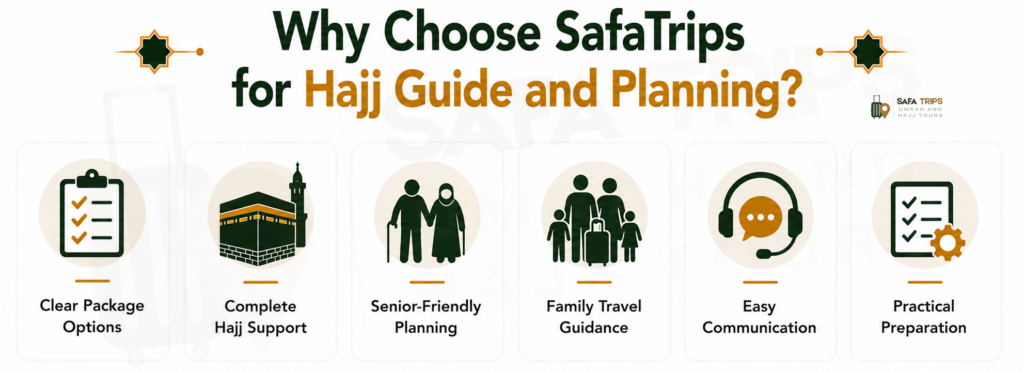
Why Choose SafaTrips for Hajj Guide and Planning?
SafaTrips helps Indian pilgrims plan Hajj with clarity, care, and practical support. We understand that many pilgrims are travelling for Hajj for the first time. We also understand the needs of senior citizens, families, women travellers, private groups, and comfort-focused pilgrims.
Clear Package Options : SafaTrips explains packages in simple language so pilgrims can compare Economy, Deluxe, Luxury, and Elite options.
Complete Hajj Support : We help with visa guidance, documents, flights, hotels, meals, local transport, Ziyarat, pre-departure guidance, and on-ground assistance.
Senior-Friendly Planning : We help senior citizens choose packages based on comfort, health, movement, and support needs.
Family Travel Guidance : Families receive guidance on room sharing, travel movement, meals, documents, and package selection.
Easy Communication : We explain the process clearly so pilgrims do not feel confused.
Practical Preparation : We guide pilgrims on packing, health, walking practice, documents, and group rules.
Plan Your Hajj Journey with Peace of Mind
Hajj is a sacred journey that needs correct intention, patience, preparation, and proper planning. Pilgrims should not treat it like a simple travel booking. They should understand the rituals, documents, health needs, package inclusions, and travel movement before booking.
SafaTrips helps Indian pilgrims plan Hajj with clear packages, visa guidance, document support, flights, hotels, meals, transport, Ziyarat, pre-departure guidance, and on-ground assistance.
Whether you are travelling alone, with family, with senior citizens, or in a private group, SafaTrips can help you choose a suitable Hajj plan based on your budget and comfort needs.
Plan early, prepare your documents, learn the rituals, take care of your health, and choose guided support that helps you focus on worship with peace of mind.
FAQs
What is Hajj?
Hajj is the annual Islamic pilgrimage to Makkah. It is one of the five pillars of Islam and is compulsory once in a lifetime for Muslims who are physically and financially able to perform it.
What is included in a Hajj Guide?
A Hajj Guide includes information about Hajj meaning, eligibility, documents, visa guidance, Ihram, Tawaf, Sa’i, Mina, Arafat, Muzdalifah, Rami, Qurbani, hair cutting, final Tawaf, health preparation, packing, and package planning.
What is the starting price of SafaTrips Hajj packages?
SafaTrips Hajj packages start from ₹8,50,000 per person for Economy – Shifting. Deluxe – Shifting starts from ₹9,75,000 onwards, Luxury starts from ₹12,50,000 onwards, and Elite plans are available on request.
Is the Hajj visa free?
Yes. The official Saudi Hajj visa is issued free of charge. However, Indian pilgrims cannot apply individually like a normal tourist visa. They must travel through the proper Hajj channel or registered operator and pay for the complete package.
Which Hajj package is best for senior citizens?
Senior citizens may prefer Luxury or Elite packages because these plans can offer better comfort and smoother planning. The best package depends on health, budget, family support, and travel needs.
Which Hajj package is best for families?
Families can choose Economy – Shifting for a practical plan, Deluxe – Shifting for a longer stay, or Luxury for higher comfort. SafaTrips helps families choose based on room sharing, meals, travel duration, and support needs.
What documents are needed for Hajj from India?
Common documents may include passport, passport-size photos, identity proof, vaccination certificate, medical fitness guidance, package booking details, payment proof, and emergency contact details. Final requirements may change based on official updates.
How should first-time pilgrims prepare for Hajj?
First-time pilgrims should learn the rituals, prepare documents early, start walking practice, attend pre-departure guidance, pack light, and follow group instructions during the journey.
Can I perform Hajj on a tourist visa?
No. A tourist visa is not valid for performing Hajj. Pilgrims need proper Hajj permission through the correct channel.
Why choose SafaTrips for Hajj planning?
SafaTrips provides clear package options, Hajj visa guidance, document support, flight planning, hotel stay, meals, transport, Ziyarat, pre-departure guidance, tour manager support, and assistance as per package.